EMT Practice Test
1. Question Content...
Question1: Who is responsible for preparing the corrective action plan?
Question2: Sampling procedures used in audits are designed to
Question3: When is it acceptable to grant an extension of the time frame for a corrective action?
Question6: 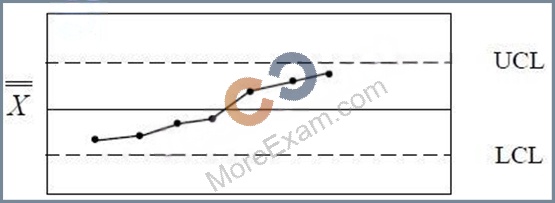
The process information shown in the graph above is indicative of a
Question8: Which of the following is most likely to request an audit?
Question10: During the opening meeting, it is the auditee's responsibility to
Question12: Which of the following represents a sound time-management technique?
Question13: Which of the following types of tools or techniques is considered qualitative?
Question14: The confidence level in a sampling plan is defined as the
Question15: The main purpose for conducting an opening meeting for an audit is to
Question16: Communication by telephone is likely to be most effective when it is used for
Question17: Measures of which of the following provide attributes data?
Question18: Which of the following behaviors is LEAST important for an auditor to exhibit?
Question20: The best way to communicate audit results to upper management would be to

Question25: Who makes the final determination regarding the distribution of the audit report?
Question28: Quality system audits are directed at evaluating the
Question29: A quality audit observation is defined as
Question31: In quality auditing, a finding is defined as
Question38: The main function of an audit checklist is to
Question41: Which of the following is the most fundamental role of the audit function?
Question49: Recognizing the need for a follow-up audit is the responsibility of the
Question50: Which of the following is a benefit of performing a systems audit of a current supplier?
Question51: During a supplier audit, all of the following documentation can be reviewed EXCEPT
Question54: Partitioning or segmenting an audit is a useful way to
Question55: Which of the following is NOT an acceptable method of verifying a corrective action?
Question57: Management of an internal audit program should consider all of the following EXCEPT
Question59: A root cause of a nonconformance is defined as a problem that
Question60: Quality auditors help companies improve their processes, products, and services by
Question64: As the last step before distributing an audit plan, an auditor should have the plan
Question66: During the course of a 10-day system audit, when should the auditee be briefed?
Question69: Auditors can use flowcharts in their work in order to
Question70: Which of the following is an audit reporting technique for prioritizing audit findings?
Question71: Management can best ensure support for the audit function from other departments by
Question74: An audit trail is necessary in order to
Question75: The type of chart that presents the value of items in descending order is a
Question77: Which of the following indicates that a quality system is effective?
Question79: Which of the following types of data is likely to be most reliable?
Question80: An audit report should contain which of the following?
Question81: Auditors who audit outside their own country should be familiar with
Question84: Which of the following is an example of a short-term corrective action?
Question85: When should audit checklists be prepared?
Question92: Which of the following best describes a frequency distribution?
Question93: A cause and effect diagram is a useful tool for doing which of the following?
Question94: A root cause analysis can best be described as a process that is used to
Question95: The objective evidence supporting an audit observation must be
Question99: During the closing meeting, the lead auditor should do which of the following?